
Thursday, November 5, 2026
During the Civil War, eagle-eyed Union soldiers at Fort Willard atop the hill in today’s Belle Haven community scoured the landscape for Confederate enemies coming up the Potomac River or along Accotink Turnpike, roughly today’s Fort Hunt Road.
On Oct. 24, the Fairfax County Park Authority honored the Olmi Family Foundation with the Eakin Philanthropy Award for preserving Fort Willard.
Fort Willard was one of the Civil War Defenses of Washington, one of the 68 Union forts and 93 batteries armed with over 800 cannons in place by 1865. After the Confederate States Army won the 1861 Battle of Manassas, President Abraham Lincoln feared Confederate attacks on Washington and ordered the military to protect the nation’s capital and its 75,000 residents. His planners chose strategic heights around the city overlooking turnpikes, railroads, bridges and shipping routes. Today, the National Park Service manages 18 of the original sites, like Fort Marcy and Fort Stevens.
The Olmis
In an interview, Eugene “Geno” Olmi said that growing up in Belle Haven, “I rode my bike through Fort Willard and my father was aghast that no one was taking care of the fort.” His father had built the houses in Belle Haven and died in 2021. In settling his father’s estate, it was clear Geno said, that his father’s intent was to preserve Fort Willard, its history and educational potential. The Olmis had purchased the land in the 1930s and 1940s, which included the fort’s remains. In 1978, they gave some of the land to the Fairfax County Park Authority. (The Olmis also built the Belle View Condominiums.)
“I appreciate that my family chose to set it aside because of its historical significance to our history. There are not many left,” Olmi said.
Park Authority’s Plans
In today’s 1.6-acre park, visitors can see the remnants of earthen fortifications and cannon platforms.
The Olmis’ recent donation will support site stabilization, tree work, invasive plant management and an archeological study to confirm the location and condition of the fort’s structures. The Park Authority will also install a raised walkway, viewing platform and five educational signs.
Thanks to modern technology, visitors will be able to “go back” to 1865. Andy Grabel, the Park Authority’s Public Information Officer, emailed, “This is envisioned to be a state of the art, immersive, interactive, educational experience accessed through a QR code link on the sign boards that reveals a 3D virtual reality model of Fort Willard as it looked in 1865 with views out to the period landscape. This landscape would include the next ring fort in the line, Potomac River and the capitol dome visible in the distance. The scene would also include soldiers going about their tasks and narrating the views.”
The Park Authority hopes to complete this work by the end of 2027.
A Redoubt
In 1863, the 742-acre Fort Willard, built by the 34th Massachusetts Volunteer Infantry, was the five-sided Redoubt D, an “appendage” to Fort Lyon, which was located near today’s Huntington Metro Station on North King’s Highway. The builders dug ditches and built 20-foot-dirt walls designed to absorb enemy projectiles, mounds still visible today.
The 400 to 500 men stationed there had two barracks, officers’ quarters, two batteries, a cook house and 10 support buildings. It was named for Colonel George L. Willard who was killed at Gettysburg at age 35.
One irony is that Fort Willard was a Union fort in a state that seceded from the Union in 1861. “The northern part of the Mount Vernon area was taken over by Union forces,” according to local historian, Glenn Fatzinger. He says that Fairfax County “went back and forth,” was occupied by both Union and Confederate forces during the Civil War.
Union troops occupied the city of Alexandria from 1861 to 1865.
The Defenses of Washington
Fort Willard was the southernmost of the Defenses of Washington.
In building the fortifications around the nation’s capital, “Soldiers and laborers worked with shovels and picks to build ramparts (walls), parapets (slopes) and bombproofs (shelters), following a standard procedure for construction. A dry moat (trench) and barricade of dead trees called an ‘abatis’ surrounded each fort,” according to a National Park Service brochure.
To build the forts, the federal government appropriated land and at the war’s end, officials dismantled most forts and auctioned off materials. The federal government returned Fort Willard’s land to the original owner, Samuel Johnson.
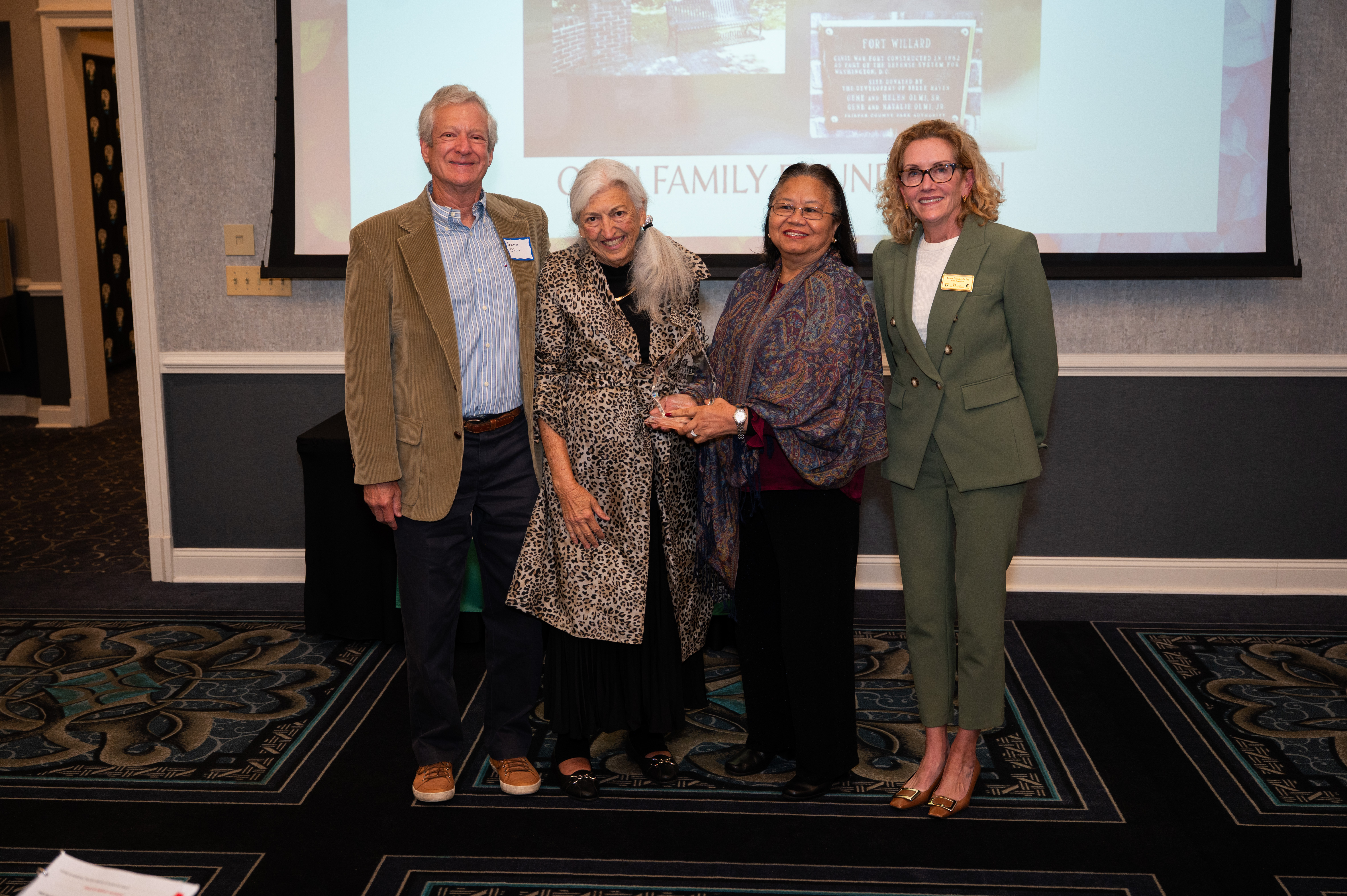 Olmi Family with Fairfax County Park Foundation Board Chair Laura Eakin Erlacher (right).